
Serg Nvns - Fotolia
Free business continuity testing template for IT pros
Business continuity testing can be a major challenge for any organization. This free template offers ways to incorporate testing into the business continuity management process.
Business continuity plans are worthless unless they are periodically tested. The key to achieving resilience during a crisis is to incorporate testing as part of the overall business continuity management process.
There are several activities an organization can run to test a business continuity plan. To ensure that staff know their roles and responsibilities, an organization might run tabletop exercises (TTX) or similar walk-through activity. IT admins can also run system-level tests in which they shut down power supplies to simulate an outage. Business continuity testing might require company-wide involvement, especially in preparation for events that go beyond a conference room.
Organizations can suffer enormous financial losses by not testing their business continuity plans. Operational downtime that extends beyond specific limits can mean loss of revenue and loss of reputation. Successful testing requires management support, time for preparation and execution, funding, careful planning, and a structured process. This process must be planned completely, beginning with pre-test activities and wrapping up with post-test evaluation and an after-action report (AAR).
This guide includes a free business continuity testing template IT pros can customize to help plan and execute a test.
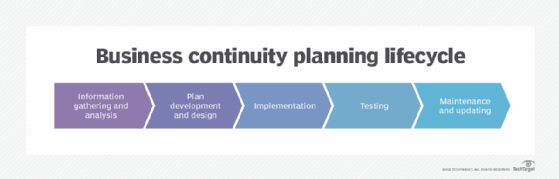
An introduction to business continuity testing
Organizations typically use one of three fundamental test types in business continuity testing: a plan review, a tabletop exercise and a simulation test. Let's examine each one briefly:
- Plan review. The business continuity plan owner and the associated team discuss the plan. They examine the plan document in detail, looking for missing plan elements and inconsistencies. This type of test does not confirm that the plan(s) will work as needed in a real incident.
- Tabletop exercise. Participants gather in a room to walk through the plan activities step by step. Tabletop exercises can effectively demonstrate if team members know their duties in an emergency. Exercise administrators use this type of test to discover documentation errors, as well as any missing information and inconsistencies across business continuity management (BCM) procedures. A TTX can also be used by disaster recovery teams to identify potential incident management measures for specific scenarios.
- Simulation. Determines if BCM procedures and resources work in a more realistic situation. It uses established business continuity resources, such as recovery sites, backup systems and other specialized tools. Teams might be sent to alternate sites to restart offsite technology and manage remote business functions. Simulations might also uncover staff issues regarding the nature of their tasks. In effect, a simulation is a full-scale, "pull the plug" test with minimal disruption to the business. To determine the type of simulated scenario, IT teams should conduct risk analyses for likely threats.
How to use the test template
The included business continuity testing template provides a starting point to prepare for and execute a test. It provides a testing framework without addressing a specific plan format. All phases of a test are included in the template: pre-test planning, test execution, post-test review and AAR preparation. The actual test activity, including test structure, scenarios, scripts and adjunct activities, such as audio and video programs, are at user discretion.
The goal of the template is to identify mission-critical systems, processes and employees; prioritize their recovery and resumption times; and describe all the steps required to restart, reconfigure and recover all mission-critical business resources. There is also space to include employee and supplier contact information.
Effective business continuity testing strategies
The template provided in this article will help improve business continuity plans. But no matter how often an organization tests its plan, when reality strikes, the response will likely be much different than in the tests.
 Click to download our free
business continuity testing
template.
Key strategies for testing include starting simple, and over time raising the bar in terms of difficulty. If possible, invite vendors and stakeholders to participate in tests. When launching a testing/exercise program, start with plan reviews and TTXs. This will help staff get comfortable with the testing process. As they improve, increase the level of test complexity. Surprise tests can be highly effective at determining the organization's state of readiness. However, such tests must not disrupt mission-critical systems and processes, if possible.
Remember that if a test fails it should not be considered a failure. It is far better to identify systems, networks and processes that may fail and remediate them before a real incident occurs.
The primary reason for testing is to identify deficiencies in business continuity plans. Ideally, successful tests will uncover and document issues with plans, processes, systems, facilities and employees. Tests that appear to be successful and uncover no problems should be further examined by IT staff to ensure that they were run correctly.
One of the key metrics that should be evaluated during testing is the recovery time objective to keep any downtime to a minimum. Another important metric is the maximum tolerable downtime. This is the maximum time the organization can function before the loss of systems, processes, people and facilities impacts the firm's ability to operate normally.
Testing frequency
Testing of the entire business continuity plan should be performed at least annually, more often if possible. Parts of the plan, such as incident response, building evacuation and various system recovery plans, can be tested quarterly or twice a year. The strategy here is to test those parts of the plan that have the greatest impact on the organization's mission-critical systems and business processes.
Editor's note: This item was updated and expanded for 2024.
Paul Kirvan is an independent consultant, IT auditor, technical writer, editor and educator. He has more than 25 years of experience in business continuity, disaster recovery, security, enterprise risk management, telecom and IT auditing.